Writer’s Craft
#06
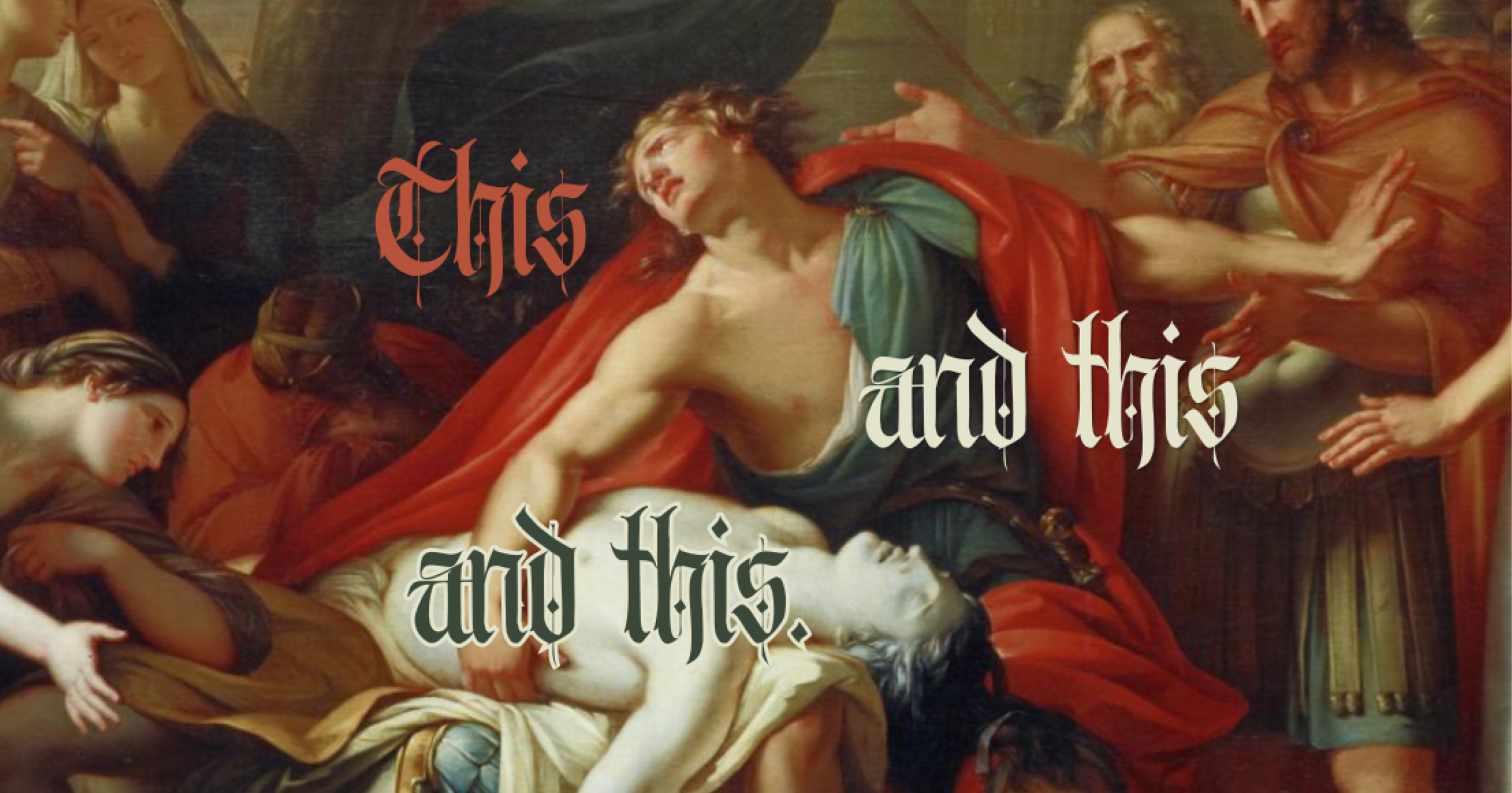
How Madeline Miller uses one sentence structure
to break your heart three times.
*WARNING* This contains spoilers for The Song of Achilles. If you’ve already read it, and if your emotional stability has the structural integrity of a peeled grape like mine, you might be devastated reading this because there are direct quotes.
If you’ve read it, you know “this and this and this.” And you know you can’t encounter it again without your whole body remembering what those words cost.
The first time they appear, Patroclus has just found, for the first time in his sad baby lonely life, someone he can talk to.
“I found myself grinning until my cheeks hurt, my scalp prickling till I thought it might lift off my head. My tongue ran away from me, giddy with freedom. This and this and this, I said to him. I did not have to fear that I spoke too much. I did not have to worry that I was too slender, or too slow. This and this and this!” (p. 49)
On first read, it barely registers. It’s sweet. A little breathless. You move on. (And if you’re like me, maybe you highlighted and tabbed it because it scratched some itch.)
But Madeline Miller is doing something here that she’ll return to. Twice. Each time in a completely different emotional register, each time hitting harder than the last. And boy does it fuckin’ HIT.
The First Time:
Loneliness Breaking Open
Let’s sit with that early passage for a sec. *Nods sagely* Because the craft in it is quiet and precise.
Patroclus has been, up to this point, defined by what he lacks. He’s not fast, not strong, not particularly wanted. He’s learned to shrink. And then Achilles arrives in his life—dazzling and with figs, yes, but most importantly, interested. Interested in Patroclus specifically, in what he thinks and knows and wants to show him.
The sentence “This, and this, and this, I said to him” isn’t describing anything. There are no nouns, no images, no objects. It’s pure gesture. The grammatical equivalent of pointing. And that’s exactly right, because what Patroclus is experiencing isn’t really about the specific things he’s showing Achilles. It’s about the act of showing. It’s about having someone to show things to.
The syntax itself enacts the emotion. Anaphora (the repetition of a word or phrase at the start of successive clauses) has been used since forever to build intensity and forward momentum. But Miller strips it down to almost nothing: no subordinate clauses, no elegant variation, just the same word hammered three times. The effect is deliberate inarticulacy. This is not the prose of someone composing beautiful sentences. This is the prose of someone too overwhelmed to construct them.
And then comes the line that unlocks the whole thing:
“I did not have to fear that I spoke too much.”
That one sentence recontextualizes everything. The “this and this and this” wasn’t just excitement, but the sound of someone who has always self-censored, who has always monitored how much space they take up, suddenly allowed to overflow. The loneliness had been active, effortful, exhausting. And now, finally, it gets to stop.
The innocence of the construction is the point. Patroclus sounds like a child here. Not because he’s immature, but because joy this uncomplicated doesn’t have access to sophisticated language. It just keeps pointing. This. And this. And this.
The Second Time:
The World Turning Inward
“We ate, then ran to the river to wash. I savored the miracle of being able to watch him openly, to enjoy the play of dappled light on his limbs, the curving of his back as he dove beneath the water. Later, we lay on the riverbank, learning the lines of each other’s bodies anew. This, and this and this. We were like gods at the dawning of the world, and our joy was so bright we could see nothing else but the other.” (p. 103)
The second use of the phrase returns right after the first sex scene that has ever made me cry—when Patroclus and Achilles discover each other ✨physically✨ for the first time. And Miller uses the same construction, but now it’s not Patroclus showing Achilles the world around them. It’s Patroclus learning Achilles himself.
That shiiiiift. The gesture that pointed outward—look at this thing, and this thing, and this thing I want to share with you—now turns inward. Now, the world being catalogued isn’t stones and carvings and sunlight. It’s a hand, a shoulder, the particular warmth of someone you love.
What Miller understands, and what makes this use so quietly perfect, is that the emotional experience is structurally identical to the first. The breathlessness is the same. The sense of overwhelm is the same. The inarticulate joy of I cannot believe I get to have this is the same. She doesn’t need new language for this new intimacy, because the old language still fits perfectly. That’s the whole point. For Patroclus, first friendship and first love feel the same in the body. Like finally being allowed to take up space. Like finally being allowed to point at things and say: this. This. This.
The Third Time:
Memory Doing Desperate Work
“But the memories well up like spring-water, faster than I can hold them back. They do not come as words, but like dreams, rising as scent from the rain-wet earth. This, I say. This and this. The way his hair looked in summer sun. His face when he ran. His eyes, solemn as an owl at lessons. This and this and this. So many moments of happiness, crowding forward.”
(p. 367)
Now jump to the end. Achilles is dead. Patroclus is dead. I’m dead. You’re dead. And in the aftermath, Patroclus is trying to hold onto everything before it disappears.
Before the phrase even arrives, Miller says the memories do not come as words. They come like dreams, like scent, involuntary and sensory and impossible to fully grasp. And then, out of that wordlessness: This, I say. This and this. It’s Patroclus trying to translate the untranslatable. Again. And we’re sobbing again. Trying to make language do something language can’t do. The inarticulate quality of “this and this and this,” which once read as innocence, then as overwhelm, now reads as the hard limit of what words can do.
And then the nouns arrive. Hair. Face. Eyes. Patroclus is fighting to be specific, to nail things down before they fade, which is exactly what makes it so gutting, because the specificity only underscores how much is already slipping. The phrase reaches for form because it’s terrified of loss.
Here’s where the three-part structure becomes genuinely fucking devastating. The reader has been trained. That sentence pattern was coded, early in the book, as the feeling of Patroclus overwhelmed by belonging. It was coded again as the feeling of Patroclus overwhelmed by love. It lives in the reader’s body as an emotional signature. A sound that means this is what it felt like to finally have someone. So when it returns in grief, the reader doesn’t just understand intellectually that this is a callback. They feel the distance between all three moments at once.
The technique hasn’t changed. The world around it has. And that gap between what the phrase once meant and what it means now is the tragedy.
Structure as Emotional Memory
What Miller does here is instructive as a writer, and moving (aka devastating) as a reader. She’s used a sentence structure not as decoration but as infrastructure.
The three uses map almost perfectly onto the stages of Patroclus and Achilles’s relationship: childhood, first love, grief. And each one earns the next. The phrase only devastates in the third act because we’ve felt it twice before—first as innocent joy, then as tender intimacy. By the time it returns in loss, it has accumulated everything. It’s a vessel that Miller has been quietly filling for 318 pages, and then she tips it over. Or smashes it over our heads or whatever.
This is the difference between a writer using a technique and a writer understanding why a technique works. The anaphora here isn’t impressive because it’s sophisticated. It’s impressive because it’s exactly right. Three times, in completely different emotional registers. Using the same five words to say entirely different things.
The Craft Takeaway
If you’re a writer, the lesson here isn’t “use anaphora.” It’s that the structural choices you make early in your manuscript are seeds. They don’t just establish character or mood, they create an emotional vocabulary the reader carries with them. When you return to those structures later, in a changed context, you get resonance for free. The reader’s memory does the work.
The question worth asking about your own manuscript: what sentences, what rhythms, what patterns are you establishing in your first act that could be doing double duty (or triple duty) by your third? And do I hate my readers enough to put them through this?
Happy writing!
Kayla
